When you think about sensory challenges, it’s natural to compare hearing difficulties directly to vision changes.
Most people understand how eyesight works because it’s a highly visual concept: If your vision weakens, the text on a page becomes uniformly blurry or faint, and putting on the correct prescription glasses brings everything back into perfect focus.
Because this experience is so familiar, many people naturally assume that hearing loss functions in the exact same manner. There’s a common belief that sounds simply drop in volume across the board, and that wearing a hearing device turns up the global volume knob, correcting the issue the way reading glasses correct a vision problem.
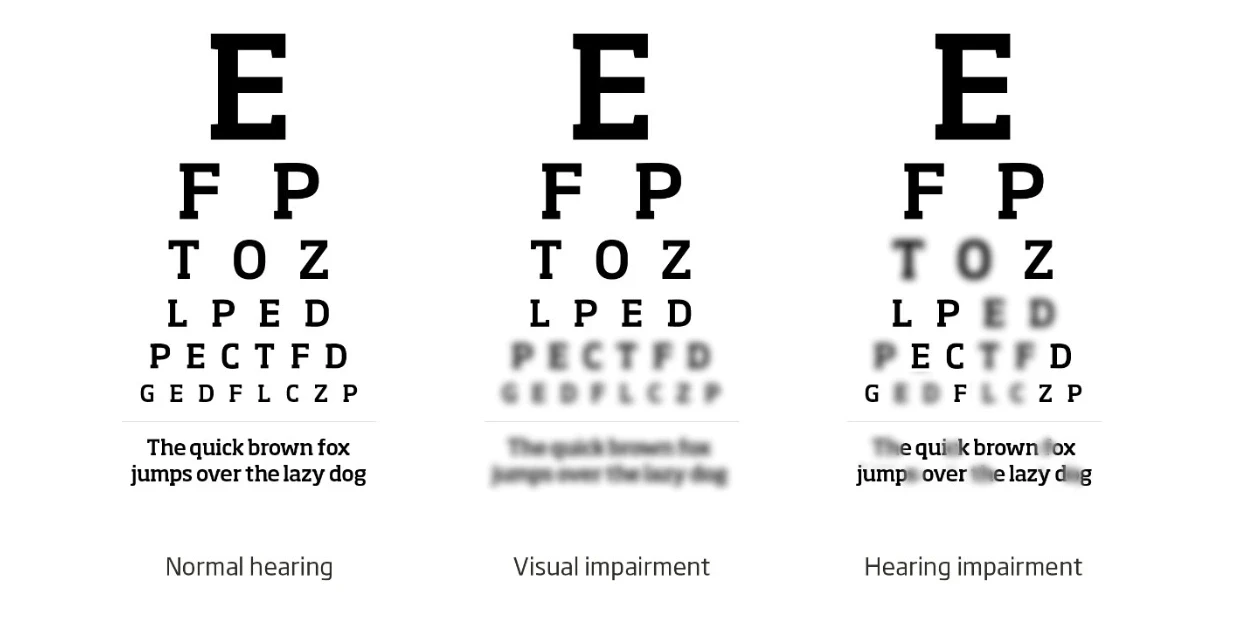
The visual chart below offers an excellent way to see why this comparison misses a critical part of the puzzle. This helpful graphic breaks down the profound differences between clarity and volume, making it much easier to understand how your ears process the world around you.
By walking through these specific examples, you can begin to see exactly why conversations sometimes feel like a puzzle with missing pieces.
The Key Difference Between Vision and Hearing Challenges
The visual chart has three distinct panels to illustrate how we experience different changes in our senses.
The first panel represents typical, healthy baseline levels, with numbers and text that perfectly sharp, bold, and distinct.
The middle panel shows a visual impairment. The letters are uniformly fuzzy and washed out, but they remain completely whole. You can still see the entire shape of the sentence, but it’s faded and blurred. This is why a person with vision changes can typically understand a word if it’s enlarged or brought closer.
The third panel tells a completely different story: a visual representation of how hearing challenges actually manifest in daily life. Rather than the entire sentence becoming evenly blurry, specific letters and sections of the words completely disappear or fade into nothingness, while other parts remain dark and legible.
You’re left with a fragmented sentence that reads more like a fill-in-the-blank puzzle than a cohesive thought. This visual demonstration reveals why simply making everything louder does not solve the underlying challenge of understanding speech.
Why Certain Voices and Words Misalign in Conversation
You may find that you can follow a conversation with a man who has a deep voice without any trouble, yet you struggle significantly to catch the details when speaking with a woman or a young child.
That’s because hearing challenges rarely affect all pitches and frequencies equally. For the vast majority of individuals, the ability to hear high-pitched sounds declines first, while the ability to hear low-pitched sounds remains relatively stable.
In human speech, vowel sounds like "a," "o," and "u" are low-pitched and carry the volume of our words. On the other hand, consonant sounds like "s," "f," "t," "th," and "p" are high-pitched and carry the actual clarity and meaning of our words.
When you experience a sloping high-frequency change, you can easily hear the loud vowel sounds, which gives you the impression that someone is speaking loudly enough.
However, because the high-pitched consonants are missing, the words lose their structure. You might easily mistake the word "cat" for "hat" or "sat" because your brain is forced to guess the missing high-frequency sounds.
How Custom Hearing Support Rebalances Your Listening Experience
Because these changes are rarely even across the spectrum of sound, your support plan must be completely customized to your unique hearing profile.
When you go through your comprehensive hearing assessment, your audiogram maps out your exact ability to hear across various pitches, revealing the precise slope of your hearing levels. You can then benefit from a personalized programming process where your hearing aids are tailored specifically to match this curve.
Rest assured that modern hearing devices are not basic amplifiers that just increase the volume of every background sound. Instead, they act as highly sophisticated, frequency-specific processors.
Your hearing aids will be programmed to lift only the specific missing points shown in that third panel of the graphic, bringing the faded elements back up to a level where they balance perfectly with the sounds you already hear well.
This precise balance restores the crispness and clarity of speech without making the world around you feel overwhelming or uncomfortably loud.
The Value of Comprehensive, Long-Term Guidance
Achieving clear, comfortable listening is a journey that goes far beyond the initial fitting appointment.
Because your brain needs time to adapt to hearing these missing sounds again, you benefit from a dedicated care approach that prioritizes ongoing support and fine-tuning.
Unlike high-volume, automated retail chains that often focus solely on the initial transaction, our independent educational clinic invests significant time into your long-term success.
You can feel completely confident knowing that your devices will be adjusted carefully over time as you encounter real-world listening situations.
Whether you’re navigating a noisy restaurant, attending a family gathering, or enjoying a quiet conversation at home, your feedback allows for precise tweaks that match your lifestyle.
This ongoing relationship with your hearing health professional ensures that your technology remains perfectly calibrated to deliver maximum clarity, comfort, and confidence every single day.
Ready to Start Your Hearing Health Journey?
If you’d like to experience hearing that is as clear and crisp as the first panel of the graphic, look no further! Our team is here to help, every step of the way.
Get in touch with us at Deegan Hearing Clinic and see what professional hearing healthcare can do to help you hear the life you love with effortless clarity.
Frequently Asked Questions (FAQs)
Q: Why does it feel like people are mumbling even though I can hear them talking?
A: This common experience occurs because your ability to hear volume and your ability to understand clarity are managed by different frequencies. You are likely hearing the low-frequency vowel sounds perfectly well, which tells your brain that someone is speaking. However, if you have a high-frequency hearing loss, you miss the delicate consonant sounds that define the boundaries of words. You benefit from a professional evaluation to identify these specific gaps so that your clarity can be fully restored.
Q: Will hearing aids make everything in my environment uncomfortably loud?
A: No. Properly fitted hearing devices do not simply amplify all background noises. Modern hearing technology is carefully programmed based on your unique audiogram; the devices only provide an explicit boost to the specific pitches where your hearing needs assistance, while leaving the frequencies you hear normally untouched. This precise, customized approach ensures a balanced and comfortable listening experience.
Q: Why do I need ongoing appointments after getting my hearing aids?
A: Your brain requires a period of adaptation to become reacquainted with sounds it has not processed in months or years. You benefit from gradual, personalized adjustments as you reintroduce these frequencies into your daily routine. Ongoing follow-up care allows your audiologist to fine-tune your settings based on your real-world experiences, ensuring that your devices perform optimally in the specific environments where you spend your time.

Amy Deegan
Owner & Hearing Instrument Specialist
Amy is the heart of Deegan Hearing Clinic. With an Honours B.A. in Speech and Hearing Sciences and years of experience as a Hearing Instrument Specialist, she combines technical experience with a personal touch.